Portable Cable Machine vs Resistance Bands vs Dumbbells: Which Is Best?
· Sabrina Wescott
The quick answer: Resistance bands are the cheapest and lightest option, but they give inconsistent resistance that's hard to measure and progress, and they can snap under tension and cause injuries. Dumbbells give consistent, measurable resistance but are heavy, bulky, and expensive to buy in a full range. A portable cable machine combines the best of both: consistent, measurable resistance up to 300 lbs (MAXPRO SC) or 125 lbs (MAXPRO Air), in a unit you can carry with one hand. For building strength at home or on the road, a portable cable machine is the most complete of the three.
All three can help you get stronger. But they work very differently, and picking the right one depends on your space, budget, safety, and goals. Here's the honest breakdown.
Side-by-Side Comparison
| Resistance bands | Dumbbells | Portable cable machine | |
|---|---|---|---|
| Resistance feel | Gets harder as it stretches | Constant, gravity-based | Consistent through the lift |
| Max resistance | Limited, hard to measure | Whatever you buy | Up to 300 lbs (SC) / 125 lbs (Air) |
| Easy to track progress? | Not really | Yes | Yes, dial settings plus app tracking |
| Breakage risk | Rubber wears down and can snap back at you | Low, but can be dropped | Low; cable retracts smoothly |
| Weight to carry | Ounces | Hundreds of lbs for a full set | 2.85 lbs (Air) / under 10 lbs (SC) |
| Storage space | A drawer | A rack or a corner | A drawer or closet |
| Movement variety | Good | Good, gravity only pulls down | Excellent, pull from any angle |
| Travel-friendly | Yes | No | Yes, TSA-friendly |
| Typical cost | $20 to $100 | $300 to $1,000+ for a range | $499 (Air) / $799 (SC) |
Resistance Bands: Light, Cheap, and Limited
Bands are popular for warm-ups, mobility, and travel when you have nothing else. They're inexpensive and fit in any pocket.
The problem is how they create resistance. A band gets harder the more you stretch it. That means the start of a movement is easy and the end is hard, so your muscles aren't loaded evenly through the full range. It's also tough to know exactly how much resistance you're working with, which makes progressive overload, the key to building strength, more guesswork than plan.
Best for: Light warm-ups and mobility, with careful inspection before every use.
The safety problem with bands: Rubber breaks down with use, sunlight, and age, and small nicks or tears are easy to miss. When a band snaps under tension, all that stored energy releases at once, and the band can whip back into your face, eyes, or hands. Bands anchored in a door or around a post can also slip loose mid-rep. Manufacturers recommend inspecting bands before every session and replacing them regularly. And the stronger you get, the more tension you put on that rubber, so the risk grows right as you start making progress.
Dumbbells: Reliable, Heavy, and Space-Hungry
Dumbbells are a gym classic for good reason. Resistance is consistent and easy to measure, and they're great for presses, rows, curls, and lunges.
The downside is everything else. To progress, you need a range of weights, which gets expensive and takes up a lot of room. Adjustable dumbbells save space but are still heavy and awkward to store. And because gravity only pulls straight down, there are movements dumbbells just can't do well, like face pulls, cable flyes, and woodchops. Forget about traveling with them.
Best for: People with dedicated home gym space who mainly do classic free-weight lifts.
Portable Cable Machines: The Best of Both

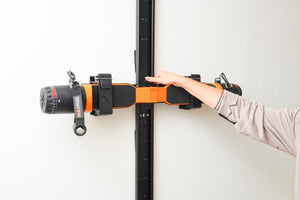
The MAXPRO SC: up to 300 lbs, set with a dial.
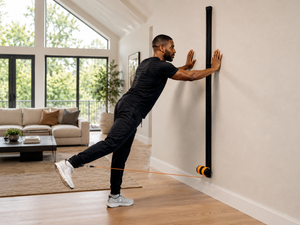
A portable cable machine gives you measurable, consistent resistance like dumbbells, in a package as easy to store and carry as bands, without stretched rubber waiting to snap.
The MAXPRO SC delivers up to 300 lbs of resistance with 50 dial settings, from a unit that weighs under 10 lbs. Its cables are 15 times stronger than steel by weight. Dual cables let you do two-handed movements like bar squats, deadlifts, chest presses, and rows. The MAXPRO Air weighs 2.85 lbs, uses Dyneema cables rated stronger than Kevlar, has a 12-foot cable for athletic and full-range movements, and goes up to 125 lbs.
Because cables can pull from any direction, you get far more exercise variety than dumbbells. And because resistance is set by a dial, progression is simple: when you hit the top of your rep range, turn it up. The MAXPRO Coaching App tracks your reps and resistance, with no subscription required.
Best for: Anyone who wants real strength training without the space, cost, or bulk of a weight set, at home or on the road.
Which Builds More Muscle?
Muscles grow from tension and progressive overload, not from a specific type of equipment. The question is which tool makes it easiest to apply enough tension and keep increasing it.
Bands struggle here because resistance is uneven and hard to measure, and pushing them harder raises the risk of a snap. Dumbbells do it well but require a lot of weights. Cables do it well in one compact unit.
The research backs this up. In a 12-week peer-reviewed study, UCLA researchers found people training with MAXPRO built strength equivalent to people using traditional weights and cable machines. Read the UCLA study breakdown →
One note: MAXPRO is concentric, meaning resistance is on the lifting phase and the cable returns smoothly. That's easier on joints and means less next-day soreness, so you can train more often. For more, see Can You Build Muscle with a Portable Cable Machine?
The Cost Over Time
Bands are cheap upfront, but they need regular replacement and many people outgrow them quickly. A decent set of dumbbells covering a useful range often costs more than a portable cable machine and still doesn't cover cable movements. A MAXPRO is a one-time purchase with room to grow for years: $499 for the Air or $799 for the SC.
The Bottom Line
If you just need something for light warm-ups and stretching, bands can work, as long as you inspect them every time and replace them often. If you have a dedicated gym room and love free weights, dumbbells are a solid choice. If you want measurable, progressive strength training that fits in a closet and goes wherever you go, a portable cable machine is the most complete option.
And the biggest factor of all? Use whatever gets you training consistently. Equipment you can grab and use in 30 seconds is equipment you'll actually use.
MAXPRO was featured on Shark Tank and named the Best Portable Smart Home Gym by Sports Illustrated.
FAQ
Is a cable machine better than resistance bands?
For building strength, yes. Cables provide consistent, measurable resistance through the lift, which makes progressive overload much easier than with bands. Cables also avoid the main safety risk of bands, which can wear out and snap back under tension.
Are resistance bands dangerous?
They can be. Bands degrade over time, and a worn or nicked band can snap under tension and whip back into your face, eyes, or hands. Inspect them before every use, replace them regularly, and never use a band that shows cracks, tears, or thinning.
Is a cable machine better than dumbbells?
Both build strength. A portable cable machine offers more exercise angles, takes far less space, and replaces a full set of dumbbells in one unit.
Can a portable cable machine replace dumbbells?
For most people, yes. The MAXPRO SC goes up to 300 lbs and covers presses, rows, curls, squats, deadlifts, and many movements dumbbells can't do.
Do resistance bands build muscle?
They can, especially for beginners, but uneven and hard-to-measure resistance makes long-term progress difficult, and the risk of a band snapping rises as you increase the tension.
What is the most space-efficient strength training equipment?
A portable cable machine. The MAXPRO Air weighs 2.85 lbs and fits in a drawer. The MAXPRO SC weighs under 10 lbs and stores in a closet.
Related: Best Portable Cable Machine · Best Travel Workout Equipment